Highest Peaks in Rupshu, Ladakh
Share on Social



JOURNEY TO THE GUREZ VALLEY
Northern Kashmir
2024
We started our trip at the well-known and popular valley of Sonamarg in Kashmir. Following this, we planned to spend few days in the remote Gurez valley. From Sonamarg we drove to Sopore, which is on the western shore of the Wular Lake.
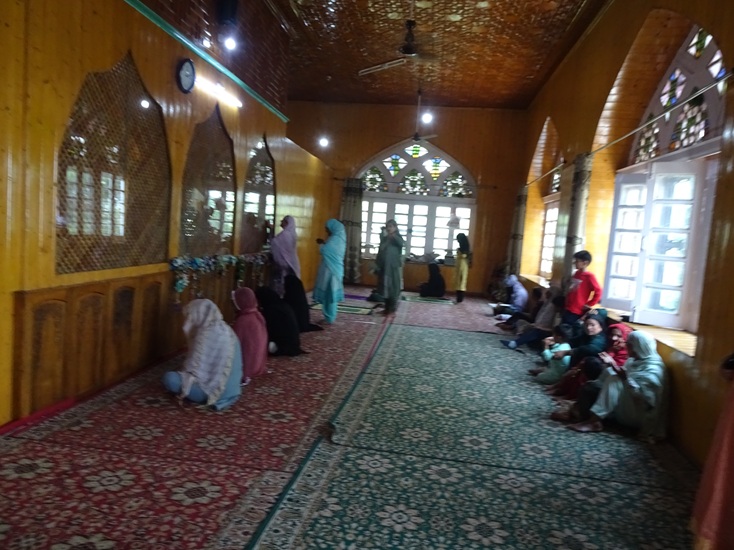
Sopore is a small town with some shops and a restaurant. We drove up the ridge on the western slopes to the “Ziyarat” (place of pilgrimage) of the Sufi Saint, Baba Shakruddin. There was a small crowd of pilgrims including some college girls who mixed freely with us and recounted stories and news, like most others in today’s Kashmir. (See End Note 1)
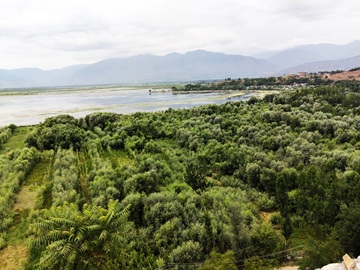
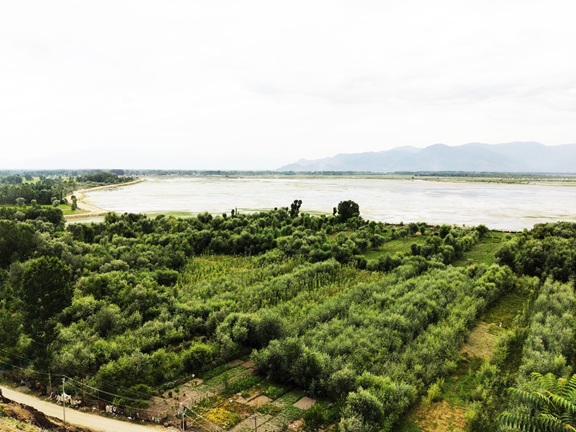
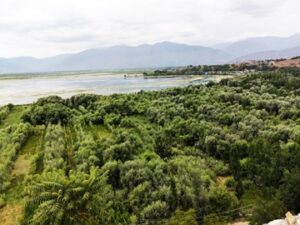
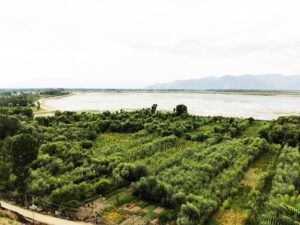
One of our prime aims for reaching this height, was to view the vast expanse of the Wular lake. Unfortunately, due to thick vegetation a clear view was impossible, and our wish remained unfulfilled. We could see parts of it from different places enroute to this Ziyarat, but the lake is so vast that only a Drone may be able to photographs it from air. After driving down and turning north we came across some fields where the view of the northern shores of the lake was clearly visible.
Wular Lake
Wular lake is about 10 miles long and 6 miles wide, one of the largest lakes in Kashmir. The fissure is filed in by the Jhelum river and the streams Madhumati and Arin. making it the largest body of fresh water in Asia. The lake has a curious shape, and it changes at various points. Finally, from the south the Jhelum river emerges to flow into Kashmr and to eventually into the Indus.
The lake, with its big dimensions and the extent of water, gives rise to high leaping waves in the afternoons, called Ullola in Sanskrit, meaning “stormy leaping, high rising waves”. Therefore, the lake was also called Ullola. It is believed to have gotten corrupted over the centuries to Wulor or Wula. The origin may also be attributed to a Kashmiri word ‘Wul’, which means a gap or a fissure, appellation that must have come also during this period. The word Wul (gap or fissure), is also an indicator of its origin to a fissure or gap created.
The lake is one of the 80 Indian wetlands designated as a “Ramsar site”. However, it faces environmental threats including the conversion of large parts of the lake’s catchment areas into agriculture land, pollution from fertilizers and animal wastes, hunting of waterfowl and migratory birds, and weed infestation in the lake itself. (See End notes 2 and 3)
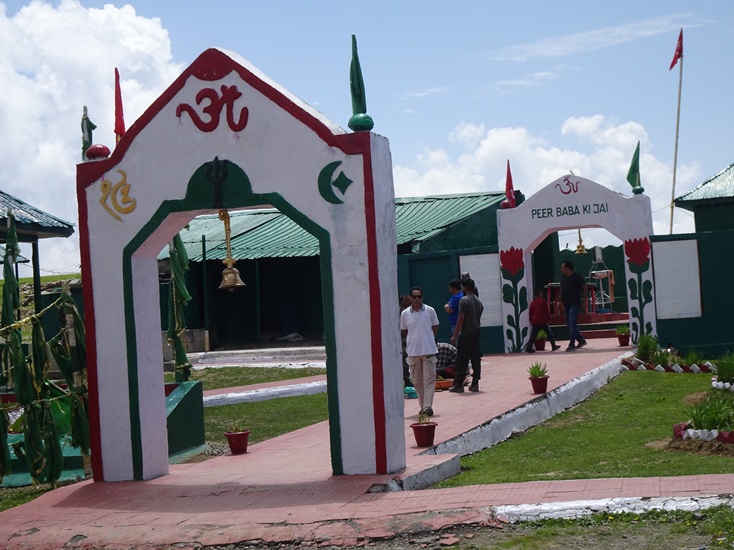
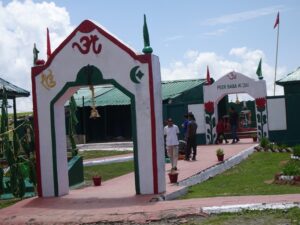
After a descent, the road started climbing up north and we approached the Razdan pass to cross into the Gurez valley. Little below the pass is a vast establishment of Peer Baba, another Sufi saint whose legend is well known here.
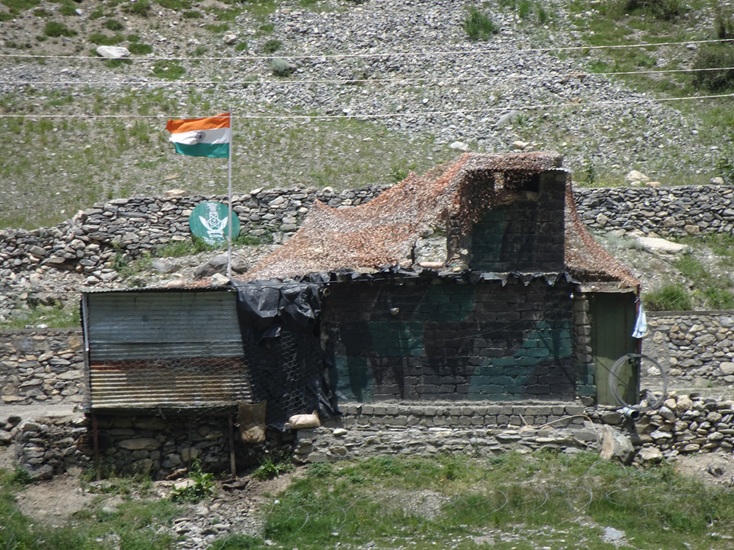
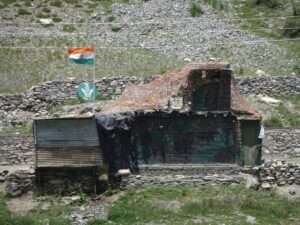
Peer Baba, a Sufi saint, is said to have come here from Sindh in Pakistan. Reaching these heights, he was enchanted by the view and stayed here till his death. His Mazar was constructed here. Legend says that the people of Bandipora in the valley decided to shift his Mazar down from this god-forsaken place which remained snow-bound for long periods, so that more people could come and worship. But on several occasions while trying to do so, a band of honeybees would always attack the party. Eventually the dargah was constructed here, a little below the Razdan pass, some way below the final ridge where the actual pass is located. The final slopes are lined with many abandoned army bunkers of various sizes. In 1947 when the Indian army arrived here, this ridge was the line of control across which the infiltrators would enter. This ridge remained the line of control until 1971. As we continued beyond the pass, we observed that the forest line had receded and above that we could observe many peaks of Kashmir and the high peaks of the Western Karakoram in POK (Pak-Occupied Kashmir) including many famous peaks.
Razdan Pass 3560 m (11,672 ft)
Historically, Gurez served as an important stopover along the ancient Silk Route, facilitating trade between the regions of Gilgit-Baltistan and the Kashmir valley. The valley boasts of several archaeological sites that are a testament to its rich historical past
The strategic importance of Gurez has been well documented throughout history. The formidable Razdan pass, at 3500 meters, served as a gateway to the valley and was heavily guarded in the times of war. The antique remains of the fort at Dawar, the principal town in Gurez, are silent witnesses to the various power struggles that this valley has witnessed. The entire location, the view and the setup of the Dargah make it worth taking a short break.
Our travel permits were checked three times by different army units and agencies, as the area is an old battle ground and on the border with POK. Soon were down in the valley to Kanzalwan where Kishen Ganga flows from the north and flows west to POK and towards Sharda Peeth a major Hindu learning University ages ago. Kanzalwan, where we turn into the Gurez valley, was the place where the fourth and last gathering of Buddhist scholars was held in 78 A.D. The typical mixture of cultures for which Kashmir is known for, was evident. Buddhist discussing theology with Hindus scholars of Sharada Peeth and the interaction of Shia and Sunni Muslims in the valley of Dards, (Gurez valley).
The Gurez Valley
Gurez valley (Or Gorais as in Gazetteer) in Northern Kashmir has a long history and unique culture.
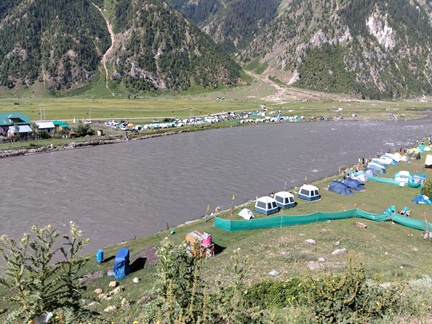
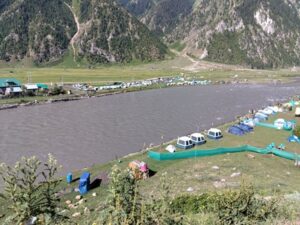
But first to its prime attraction- the Kishen Ganga river, which drains the valley. Many smaller nalas pour into it to make the main river. Apart from a few summer months, the Kishen Ganga can be crossed with little difficulty. Hence one finds a barbed wire fence on both sides of the river to stop and infiltration into the village.
The valley is covered on three sides by POK. After the first war in 1947, Pakistan controlled this valley, but it was in 1971 that the Indian Army moved in and with support of the local population established control. Though they are Dards, a typical Shia Muslim community, they have more connections with the Sunnis of Kashmir.
About Gurez Valley
The valley is divided into two districts. The area between Razdan pass and the town of Dawar comes under the Dawar district. Beyond that, the region between Dawar and Chakwali falls under the Tilel district. In terms of tourism, the small town of Dawar is pretty much the heart of Gurez and the tourist hub.
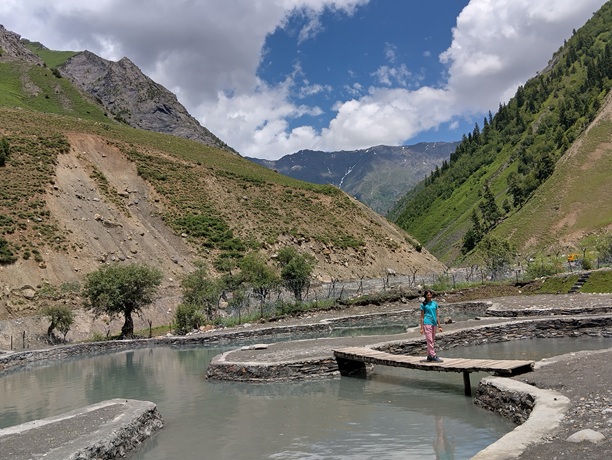
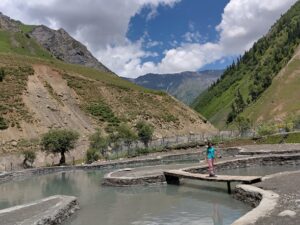
Being so close to the border, it is actually what you may as well call a forbidden beauty, though vistas will leave you spellbound at every turn. Snow-capped peaks standing at a distance, a river flowing through, a gush of cold winds, dense forests, green meadows and a few wooden houses in the middle of nowhere, that is the Gurez valley. It is a place that seems like straight out of a painting.
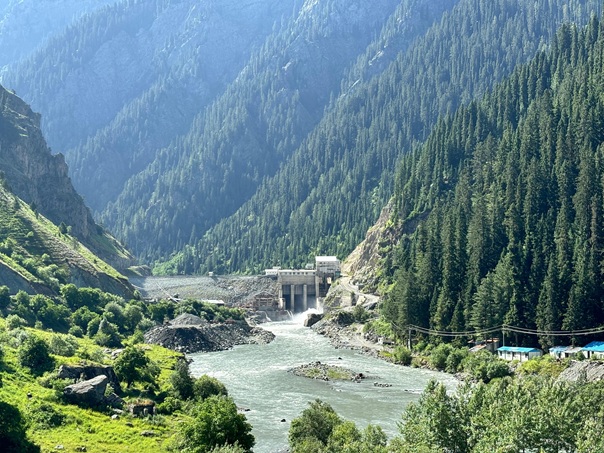
As you climb down the Razdan pass and enter Gurez valley, you will be greeted by the restless, noisy, and beautiful Kishen Ganga river, now with a lake due to the Kishen Ganga dam.
The Haider Ridge and Kishenganga
One of the farthest points in the Gurez valley now is the Chakwali post. This was our first point of call. It is deep inside the valley and at a junction with three valleys. From the northeast, Kishen Ganga flows into the Gurez valley. This valley is connected with a rough road leading to the Dras and Kargil areas. Naturally, it is heavily guarded and not open to civilians yet to travel.
As per the legend, the Five Pandavas (of Mahabharata) and their wife Draupadi, followed this river from the Kashmir valley on their final journey to heaven. As per custom, they were required to undertake a ritualistic bath in the small stream. By the time it was the turn of Draupadi, wife to all five brothers, the stream dried up. The lady was left literally, high and dry. She prayed to Lord Kishna to help her complete the ritual bath. Krisha obliged and shot his arrow aimed at ground which produced a stream large enough to be called a river. Draupadi had her bath and thanked “Kishen” another name for the Lord. The river is now called “Kishen Ganga” and flows in the centre of the Gurez valley down steam, till it takes a sharp south-westerly turn.
Towards the west of Chakwali runs a long and narrow valley. It ends at the foot of the high ridge, named as the Haider Ridge after a soldier. This is ridge is the border between India and Pak-occupied Kashmir. It is heavily guarded by the army, which is a major infiltration route into the valley. With naked eyes, one can see some Pakistani army posts high on the ridge, which may be abandoned now.
The river flowing from the Haider complex meets the Kishen Ganga at Chakwali. But not being fed by a glacier or perennial snow it is small and can be easily crossed at most times of the year. As it flows into the centre of the valley, it is fenced on both banks with barbed wires to prevent infiltrators, giving the valley a surreal look and you are always reminded of being in the conflict zone.
Kishen Ganga flows past the Dawar village in the centre to the foot of Razdan ridge guarding the main approach into the valley. It takes a sharp 90 degree turn to the southwest and flows into the Pak-Occupied Kashmir and is called the Neelam river which continues till Muzaffarabad (old name Domel) to merge with the Jhelum river.
Sharada Peeth
About 20 km into the POK across the Line of Control stands the Sharada Peeth, which was once a renowned centre for learning. This ancient site which flourished as a hub of academic and scholarly excellence attracted scholars, academicians and students from far-away lands who came here to study or immerse themselves in higher pursuits. Tragically, this magnificent temple now lies in ruins, completely forgotten. Due to its location in a highly sensitive area in POK, even the pilgrims who might have frequented it and helped in its upkeep have no access.
Sharada Peeth is a ruined Hindu temple and ancient centre of learning located in the Neelum valley of Pakistan-Occupied Kashmir in the disputed Kashmir region. Between the 6th and 12th centuries CE, it was among the most prominent temple universities in the Indian sub-continent. Known in particular for its library. Stories recount scholars travelling long distances to access its texts.
Sharada Peeth (the seat of Hindu Goddess Saraswati) was once regarded as a major centre of higher learning of Vedic works, scriptures and commentaries. Sharada Peeth, one of the 18 highly revered temples across South Asia, was once at par with the ancient seats of learning at Nalanda and Takshshila
(J and K Gazetteer)
It is said that when foreign invaders threatened the region where Sharada Peeth now stands, Goddess Sharada undertook a divine intervention to protect the sacred texts which were the source of vedic knowledge and wisdom. These manuscripts were hidden in a container in a hole in the ground. She transformed herself in a structure to cover the hole and this structure was the famous Sharada Peeth temple.
Besides the temple, the ruins of one of the country’s oldest universities, called Sharada University also stands here. The university had its own script known as Sharada and it is said that it once had over 5000 scholars and housed the biggest library. The shrine holds great significance value to its devotees as the goddess of learning and knowledge and Sharada or Saraswati, is the principal deity of the Kashmiri Hindus.
The shrine now, reportedly doesn’t have a deity except for large stone slabs. It is said that a Shivling (symbolic idol of Lord Shiv) once rested just outside the shrine. The interiors of the temple are unadorned. The stairway leading to the shrine is around 10 feet in width and each step is more than a foot in height and 2 to 3 feet deep.
The main temple continues to stand on its own strength. Its three walls are in good condition although the door and the roof are missing. I could imagine that the door and the roof were made of wood and hence perished with age, Nazki writes. “There were no signs of encroachment over the complex and the place was neat and clean.
The temple is also regarded as a Shakti Peeth, a shrine built on places where body parts of Sati Devi had fallen while being carried by her husband Lord Shiva.
Kashmiris and locals are keen to open the trail through POK to visit Sharda Peeth with an arrangement with the Pakistani Government, as it was done in case of Sikh shrine in Kartapur, in Punjab, which was opened for Sikh pilgrims to travel into Pakistan to visit it.
But today, Sharada Peeth, is an abandoned temple, close to the Line of control (LoC), near POK’s Sharada village in the Neelum valley (at a distance of around 140 km from Muzaffarabad capital of POK and 30 km from Kupwara). Hence, it has remained out of bounds for Indian pilgrims since Partition.
(See End Note 4)
Early Visitors to the Gurez valley
Life in the Gurez valley was in turmoil after the Indian independence in 1947, due to attack by Pakistan based kabalis. Gurez was out of bounds for decades. Except for the Indian army there were no visitors. But, earlier since ancient times there were several visitors who visited the Gurez valley. Gurez valley was an important stop to the main Silk Road from Kashmir. Hence many caravans passed through here.
Gurez had been a destination for foreign tourists, including Franklin Delano Roosevelt who is known to have visited Gurez some time before he became the US president. Nehru and Indira Gandhi, accompanied by Sheikh Abdullah, were among those who visited this area in the 1940s, fishing for trout at Naranag, one of the lakes in the mountains above the valley.
The English rock climber Oscar Eckenstein was one of the earlier climbers to visit the Gurez valley in 1890. Like all other British visitors, he was enchanted by Kashmir and upon seeing a blooming garden in Srinagar recalled London’s Hampstead Heath., He in particular noted similarities between the Swiss countryside and Gurez, which then was an intimate clasp of small villages in the Kishanganga river valley.
“The scenery here exactly resembles the Swiss but is on a larger scale,” he wrote.
Gurez was mapped in greater detail by Sir Walter Roper Lawrence, an English civil servant, in his 1895 book, The Valley of Kashmir. He ventured that someday the sweep of its harsh mountain crags, soothing teal streams, and freshly tilled plains might pry visitors away from the more obvious appeals of Kashmir’s other prominent vacation spots.
“Perhaps Pahalgam, the village of the shepherds that stands at the head of the Liddar valley with its healthy forest of pines, and Gurez, which lies at a distance of thirty-five miles from Bandipora, the port of the Wular Lake, will before long rival in popularity the other margs. Gurez is a lovely valley five miles in length lying at an elevation of about 8000 feet above the sea. The Kishen Ganga river flows through it, and on either side are mountains. The climate is dry, and mild, excellent English vegetables can be grown, and the wild raspberries and currants are delicious.
“The valley is extremely picturesque, as the river comes dashing along through a rich meadow, partly covered with lindens, walnut and willow trees, while the mountains on either side present nothing but a succession of most abrupt precipices, and Alpine ledges, covered with fir trees.
In the years since, Pahalgam has not completely fulfilled the promise of Lawrence’s expectations. Gurez, which adjoins the heavily guarded Line of Control (LoC) bordering Pakistan-occupied Kashmir (POK) in Kashmir valley’s north, remained off-limits to travellers until 2007. Restrictions are now lifted, but only for Indian visitors.
Habba Khatoon
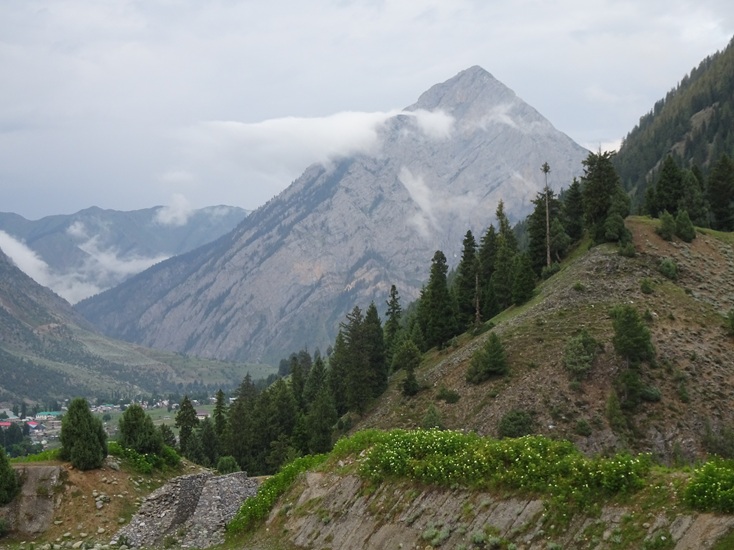
Any visitor to Gurez will first be awestruck by the view of a high peak at a distance in the centre. This is Gurez’s most formidable peak, Habba Khatoon, around which legends abound. This pyramid shaped peak was named after the Kashmiri poet Habba Khatoon.
Habba was a beautiful and intelligent woman from Saffron village Chandhara and originally known as “Zoon” (which means Moon in English). She was the daughter of a peasant Abuddi Rather, who married her to an illiterate peasant boy named Habba. Zoon was ill-treated by her mother-in-law and husband, because she spent most of her time poetry and singing. Dejected by her plight, she changed her name to Habba Khatoon.
The emperor of Kashmir, Yousuf Shah Chak, was enthralled by her beauty, intelligence and poetry. He arranged her divorce from Habba and married her. According to the story, Shah Chak was imprisoned by his rival King Akbar. Habba Khatoon used to wander near the peak, that now bears her name, to look for her lover. After her husband’s death, she wandered the banks of river Jhelum in mourning. She died twenty years later by drowning into the Jhelum and now her tomb is at Athwajan.
(Frontline, November 2023. by Lakshmi Sankaran)
Valleys and people
There are several side valleys emerging from the main Kishen Ganga valley. The Tulail valley, a sub-tehsil of Gurez was established in 2014. In tiny hamlet, women, young and old, carry firewood across shaky bridge planks and stack up logs to build their ancient wooden cabins. These are Gurez’s original settlers the Dards, various tribes from Dardistan, who speak a language called Shina. In antiquity, Dardistan encompassed some of the uppermost mountain reaches of India and Pakistan. After Partition, Dards have largely been consigned to Gurez, struggling to preserve their heritage even as their surroundings are rapidly modernised.
In the centre of the valley is the Dawar village, the headquarters of the valley. Khadiyal Point, developed for tourists is a flat ground nearby where tourists gather to view the sunset. Sightseers should take note of two new attractions: the Shinon Meeras centre, a museum dedicated to the Dard-Shin heritage. Now there is a 130-kilometre road connecting Gurez to Mushkoh valley in Kargil. Thus, Gurez has all along Pakistan as its immediate neighbour.
Gurez valley is a near-perfect picture of Himalayan idyll, if not for the barbed LoC wire running along the rock face flanking the river, a reminder that temporary silence ought not to be mistaken for lasting peace.
May be these difficult circumstances have protected Gurez, keeping hordes of tourists away, just as the army kept the invaders away.
A Gurez with too much development, which will be required for large tourism influx, might lose what made it special in the first place. Decades ago, Joni Mitchell had warned about paving paradise to put up parking lots, and Gurez seems perched on the cusp of a similar upheaval. The world outside should go gentle on this beautiful valley.
(Ibid. Frontline)
End note 1
Shrine of Baba Shukar-ud-din Wali on the Wular Lake
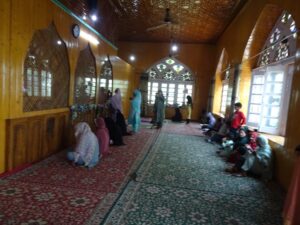
Kashmir is one of the region in the Indian subcontinent which is known as Reshe Vaer (abode of saints). These saints or holy men are commemorated and enshrined in different parts of the valley. People visit their shrines from every nook and corner to seek spiritual guidance and mental peace. One among these shrines is that of Hazrat Baba Shukar-ud-din Wali at Kraale Sangi (Sharikot Hill) in Watlub, Sopore. This shrine is visited by devotees throughout the year and is popularly known as Babe-Shukrun.
Born at Arith Pargana, Machhama district Budgam, in 790 Hijri as per Islamic calendar, Baba Shukar-ud-din Wali received spiritual training for a few years. He was told to go to Sharikot Hill in Watlub, Sopore, and meditate. Here, the Peer Baba assisted the locals and performed miracles. As his fame grew, people from all religions flocked around him to seek help and spiritual guidance in different matters.
At his “Ziyarat”, there is an exquisite decorated wooden door which is permanently displayed at the entrance of the shrine. One must not forget to look at this door and feel the craftsmanship by touching it when one happens to visit this famous shrine. Hundreds of devotees visit this shrine to seek peace and spiritual guidance. Baba did not discriminate between Hindus and Muslims. From this “Ziyarat”, which is on a hill, one can have an awesome view of Wular Lake, Asia’s largest freshwater lake.
End note 2
Ramsar site
A Ramsar site is a wetland site designated to be of international importance under the Ramsar Convention, also known as “The Convention on Wetlands”, an international environmental treaty signed on 2 February 1971 in Ramsar, Iran, under the auspices of UNESCO. It came into force on 21 December 1975, when it was ratified by a sufficient number of nations. It provides for national action and international cooperation regarding the conservation of wetlands, and wise sustainable use of their resources. Ramsar treaty participants meet regularly to identify and agree to protect “Wetlands of International Importance”, especially those providing waterfowl habitat.
As of October 2024, there are 2521 Ramsar sites around the world, protecting 257,317,367 hectares (635,845,060 acres), and 172 national governments are participating.
(From Wikipedia)
End note 3
Wular Lake
This is one of Asia’s largest freshwater lakes. It changes character with every few miles. From Watlab, the Wular Lake stretches away as far as the eye can see, edged by picturesque villages around terraced breeze-rippled fields of paddy, in a riotous burst of colour. The sheer grandeur of the spectacular countryside is to be seen at leisure.
Wular lake is the largest freshwater lake in India and Asia and lies in the Kashmir valley, 40 km northwest of Srinagar City in the Northwest of India The lake lies at an 1580 m. Its maximum depth is 14 metres, it has a length of 16 km and a breadth of 10 km.
The lake and its surrounding extensive marshes host important natural wildlife. The rivers Bohnar, Madamati and Erin from the mountain ranges and the rivers Vetasta (Jhelum) and the Ningal from the south bring hundreds of tons of silt into the lake every year. This rampant siltation and the human encroachments have devastating effects on the lake.
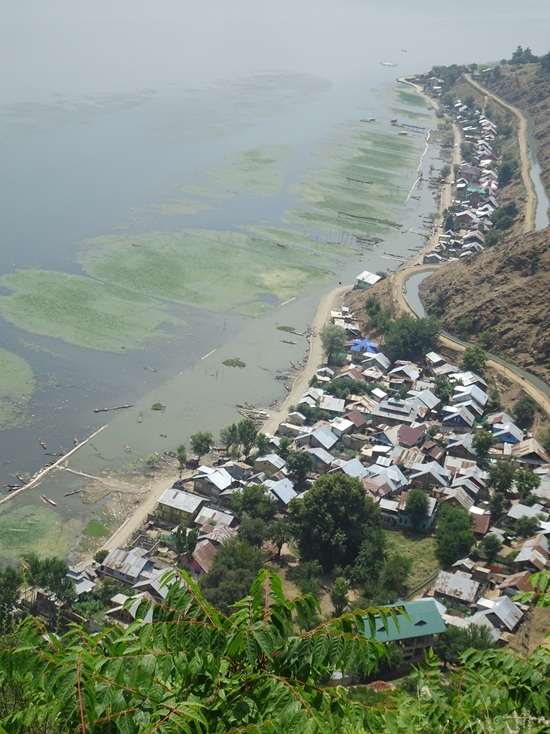
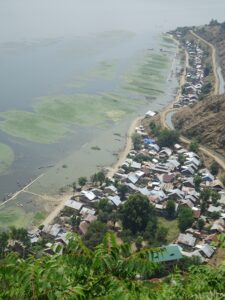
The mountainous roads near the town of Bandipora surround what looks like a huge meadow. A closer look reveals that the meadow is actually the water of Wular lake hidden by floating vegetation, agricultural plots, and intentionally planted trees.
Wular’s degraded state has not only ruined its prospects for tourism but has also compromised the lake’s function in absorbing heavy snow and ice melt from the mountains.
Celebrated Bard Iqbal asked the relevant questions.
The earth is experiencing tremor after tremor,
The warnings of Nature are but too clear.
Khidr [Khizr], standing by Wular, is thinking:
When will the Himalayan springs burst?
— Urdu poet Dr. Mohammed Iqbal (1877-1938)
How long will they remain hidden from the world,
The unique gems that Wular Lake holds in its depth.
— Ibid, Iqbal
Restoring such a lake in Kashmir — where decades long violent conflict often supersedes all other government plans — may be near impossible.
Sixty percent of the fish produced for Jammu and Kashmir come from this lake area, but with fish populations declining, the fishermen are quickly losing their income.
The Wular Conservation and Management Authority was created in 2012 and has been slow to implement the proposed efforts to clear the water body of weeds, trees, and siltation.
Water-borne diseases result from the soiled waters since the surrounding settlements collect their drinking water from the lake.
End Note 4
Sharada Peeth
The story behind the foundation of the Sharada Peeth goes back to the time when the Kashmiri Pandits transformed their land of scenic beauty into an intellectual centre, known as Sarvajnanpeetha. Goddess Sharada was also referred to as Kashmira-Puravasani. The temple has been completely deserted since Partition in 1947. Travel restrictions on Indians also discouraged the devotees from visiting the shrine.
Goddess Sharada is revered by the Pandits (Hindus) of Kashmir and prior to the partition, they used to visit this place on a yearly pilgrimage. In fact, Sharda or Saraswati is the Goddess of learning and many scholars spent years studying here. The architecture of this temple differs from most others. It has four doors, each facing a direction. It is said that except for the southern door, all the other three doors used to be “opened” amidst competition amongst scholars from different communities. The Indian sage Shankaracharya, who was from south India, challenged the scholars to philosophical arguments in a bid to have the southern door opened.
As Shankaracharya was about to enter the door, Sharada Devi challenged him saying that he was impure for having lived inside a body in the past. But quoting scriptures, he convinced her that he was pure as he had not soiled his own body.
Gurez Valley